Indigenizing the Learning Environment
"Efforts to “Indigenize” show respect for the validity, knowledge and perspectives of Indigenous worldviews and provide an opportunity for Indigeneity to be expressed in the classroom. This work leads to ways in which we might begin to decolonize education, improving education outcomes for Indigenous students and educating non-Indigenous students on their role in the reconciliation process. The primary goal of decolonization in education is to restore the Indigenous worldviews, culture, and traditional ways and enhance efforts to reconcile."
-adapted from University of Alberta Workshop by Jennifer Ward, 2017
Where do I begin?
One of the most challenging things as an Educator is to know how to integrate Indigenous ways of knowing without cultural appropriation. In reading the document, " 100 Ways to Indigenize and Decolonize Academic Programs and Courses" I chose three goals to integrate First Peoples connections into my daily teaching practice.
-
Acknowledge the Land we are on as part of our daily routine.
-
Visit an Indigenous community or invite an Elder into the classroom.
-
Create Cross Curricular Connections to the First Peoples Principal of Learning.
REFLECT:
Read the document below and choose one principle that you could add to your teaching practice.

World Citizen Glasses
Become an Ally
Equity vs. Equality
Culturally Relevant
Education
As an educator, I have often said in order to best serve our students, we need to see the world from their eyes. Tamiko Nicholson shares her professional experiences in her video on TedX WhyteAve about "Using World Citizen Glasses".
What she had to say really resonated with me.
My world citizen glasses help me to be curious about people around the world and I am appreciative of the opportunity to learn from the culturally diverse students that are part of my classroom.
Becoming a better ally means that you are taking action for change. You are advocating for others from marginalized or multicultural groups. You are standing up for those who are still finding their voice. As an educator you are creating a safe and welcoming learning environment for all cultures, language, and differences.
I began to think about the ways that I could become a better ally. They are:
-
I can say something when people are engaging in racist discussions.
-
I can share what I have learned about people's negative experiences to educate others.
What is the difference?
Equality means teaching to 'all' students the same where everyone has equal access to materials and resources.
Equity is based on the ‘individual’ where they have access to the same resources but are provided supports through differentiation and based on their diverse learning needs.
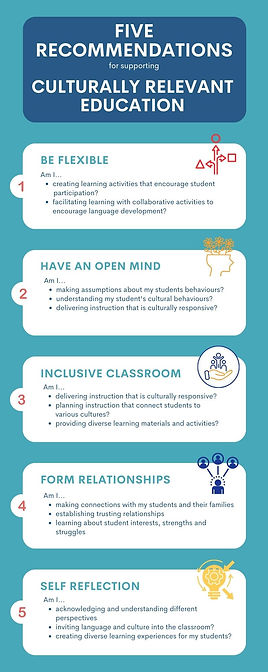
Culturally relevant education creates a welcoming learning environment where students feel acknowledged and valued. It is fostered by culturally responsive teaching that develops student identity by inviting language and culture into the classroom as learning opportunities which grow into engaging and interactive activities that are designed to create diverse learning experiences for every student.